


- Version
- Download 0
- File Size 352.65 KB
- File Count 1
- Create Date 12/01/2026
- Last Updated 12/01/2026
Login is required to access this page

DOI:
A DOI will help Author(s) easily locate a document from your citation. Think of it like a Social Security number for the article you're citing — it will always refer to that article, and only that one. While a web address (URL) might change, the DOI will never change.
Where can i find DOI:
Benefits:
What type of papers does International Journal of Scientific Research in Engineering and Management (IJSREM) publish?
Research Paper, Survey Paper, Informative Article, Case Studies, Review Papers, Comparative Studies
How long does it take for an accepted paper to be actually published?
Approximate will inform within 24 hours via email and sms.
What is the procedure to submit my paper?
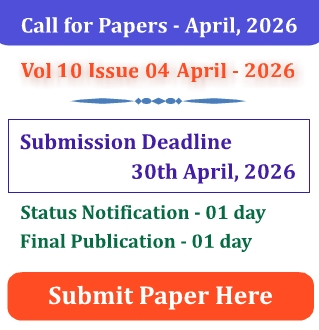
Please Submit your Research Paper here Submit Research Paper Online - IJSREM
What is a Paper ID?
Paper ID is an Unique Identification Code provided to your submitted Manuscript. You should always mention the Paper ID during any communication with us.
How long my published paper will stay online?
Lifetime.
May I submit more than one article?
We will accept multiple submissions across multiple communities, as long as the author joins each community.
IJSREM is one of the world's leading and fastest-growing research publications with the paramount objective of discovering advances by publishing insightful, double-blind, peer-reviewed scientific journals.
The Submitted Article/Paper will accept within 12-24 Hours, and it can publish within 24 Hours
Manuscript Submission - Check Manuscript Plagiarism - Send for Editorial Review - Final Decission to Author - Payment of Publication Fee - Re-screening - Final Publication
For Management, Hosting & Office Expenditure IJSREM Journal may charge some amount to publish the paper.
To Publish a Paper ₹: 800/- INR (without DOI)
₹:1000/- INR (with DOI)

To the extent possible under, Indospace Publications has waived all copyright and related or neighboring rights to Journal. This work is published from India.
Disclaimar Privacy Policy Terms and Conditions
Copyright © 2023. All Rights Reserved 
Mon – Sat: 9:00 AM – 6:00 PM
Sunday: 9:00 AM – 1:00 PM
International Journal of Scientific Research in Engineering and Management (IJSREM)
📍 #62/1, New No 7, 1st Cross, 2nd Main,
Ganganagar, R T Nagar, Bangalore North,
Bangalore, Karnataka, India – 560032